Why creativity is an unfair growth advantage.
A lot of companies still think creativity belongs in the marketing department (and some don’t even believe that).
A lot of companies still think creativity belongs in the marketing department (and some don’t even believe that).
You can usually tell within five minutes.
The brand looks fine. The website is functional. The sales deck says all the expected things. The onboarding works. Support tickets get answered. The product technically solves the problem.
And yet the whole business feels forgettable.
Nothing seems to stick and nobody talks about it unless they absolutely have to.
The company operates like a machine built entirely out of utility and function. Which sounds rational until you realise humans don’t actually buy like rational machines.
They buy emotionally first, then justify it intellectually afterwards. And they always have.
The funny thing is most execs know this when they’re consumers. They’ll line up for certain restaurants, wear certain shoes, obsess over certain cars, overpay for certain tech products, follow certain creators, defend certain brands online like unpaid employees. Pure emotional gravity.
Then they walk into work and suddenly become procurement robots.
“We just need to communicate the features clearly.” Yeah, cool. Good luck with that!
Attention has become the scarcest commercial resource in the market. Not information, not products, not software. Attention.
And creativity is one of the few things that consistently earns it.
Original thinking, emotional intelligence, taste, timing, and the ability to make people feel something before they fully understand why.
That’s a real growth asset.
The companies winning right now understand this at a systems level. Creativity isn’t decoration sitting on top of the business. It’s built into the business itself.
It’s built into the products, the onboarding, how the founder speaks, into sales conversations, hiring, events, the customer experience, internal culture, media, etc, etc, etc.
It’s embedded into the tiny moments most businesses treat as operational admin.
The strongest brands don’t feel assembled by departments. They feel seamless and coherent. You can feel the thinking running through them.
That coherence compounds commercially in ways spreadsheets struggle to model properly.
Because attention creates familiarity. Familiarity creates trust. Trust creates preference. And preference reduces acquisition friction everywhere.
Sales cycles shorten because people already want to believe. Recruitment gets easier because talented people are drawn toward energy. Customers forgive mistakes more easily. Word of mouth increases. Content performs better. And retention improves.
Even pricing pressure changes. People tolerate premium pricing when they emotionally value the thing behind it.
This is why magnetic brands outperform purely functional ones over long periods of time.
And “magnetic” doesn’t mean loud.
Some people hear creativity and picture neon sneakers, beanbags, LinkedIn marketers using the word storytelling seventeen times an hour, or agencies trying to win awards nobody outside advertising cares about.
That’s not what I mean.
Some of the most commercially intelligent brands in the world are creatively restrained. But they still understand emotional gravity.
Apple understands it.
Patagonia understands it.
Liquid Death understood it selling canned water, which still sounds ridiculous when you say it out loud.
Even boring industries need it. Especially boring industries.
In fact, the less emotionally interesting the category is naturally, the bigger the opportunity often becomes.
Because most competitors default to operational sameness.
Look at industries like accounting software, logistics, insurance, property management, compliance platforms, enterprise SaaS. Huge markets full of companies saying almost identical things in slightly different templates.
Every website starts sounding like it was assembled by the same exhausted committee.
“Trusted partner.” “Customer-centric.” “Streamlined solutions.” “All-in-one”.
Nobody remembers any of it because nobody feels any of it.
The irony is these businesses often spend millions optimising conversion while ignoring the thing that reduces conversion friction in the first place: emotional preference.
Creativity is commercial infrastructure. And that’s the bit people miss.
They think creativity sits downstream from strategy when it actually shapes how strategy gets received by human beings.
A brilliant operational system nobody notices is still commercially vulnerable.
An average product with strong emotional positioning can outperform a technically superior competitor for years, or even sometimes decades. History is full of examples.
And before somebody says “well eventually the product matters”... yeah, obviously. The product has to work. You can’t polish garbage forever. Eventually reality catches up.
But product alone rarely creates momentum anymore because competence has become widely accessible.
AI will accelerate this even further. That’s the part I think many businesses still haven’t emotionally processed.
AI is flattening execution.
Everything average will become infinite (and cheap). The ability to generate copy, design, strategy and code have all become easy thanks to AI.
The market is about to drown in technically competent sameness. Which means distinctly human creativity becomes more valuable, not less.
Taste is gonna matter more. Originality will matter more. Perspective matters more. Humour is gonna matter alot more. Emotional intelligence matters more. The unique ability to connect seemingly unrelated ideas matters more. And the ability to understand culture without obviously trying to exploit it matters more.
People keep framing AI as a replacement for creativity when it’s actually exposing how little genuine creativity existed inside many companies to begin with.
A lot of businesses weren’t differentiated by thinking. They were differentiated by executional barriers and those barriers are collapsing fast.
So now we get to see who actually understands humans (understands their customers).
And honestly, this is where many operationally-minded businesses get uncomfortable because creativity feels hard to measure cleanly.
Creativity can feel unpredictable, subjective, messy. And yeah, sometimes it is messy. But so are people!
And businesses that ignore human psychology because it’s difficult to model usually end up losing to businesses that embrace it properly.
The strongest operators I’ve worked with eventually understand this. Usually after watching a competitor with a weaker product attract more attention simply because they understood how to make people care.
Humans are emotional creatures pretending to be rational creatures. Markets (and ROI) reflect that reality constantly.
Which is why the best businesses don’t separate creativity from operations.
They systemise it.
Not in a sterile “innovation framework” way. God. Most of those workshops produce nothing except Post-it notes and catered lunches.
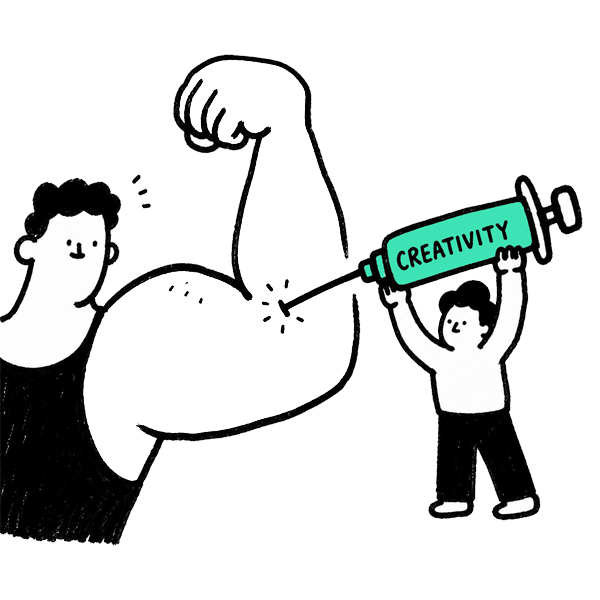
I mean they intentionally build environments where original thinking, emotional awareness, customer understanding and experimentation become part of how the company operates daily. The systems amplify the creativity, and that’s their unfair advantage.
Because creativity without systems burns out and systems without creativity become invisible.
The real magic sits in the combination.
That point is worth repeating: creativity needs systems, and systems need creativity.
A company that deeply understands people and consistently operationalises that understanding across every touchpoint becomes very difficult to compete against. Not impossible, but difficult.
You feel it when you interact with them. The business has momentum before the salesperson even speaks.
That’s the secret sauce everybody keeps looking for: A deeper understanding of humans, translated consistently through systems people actually experience.