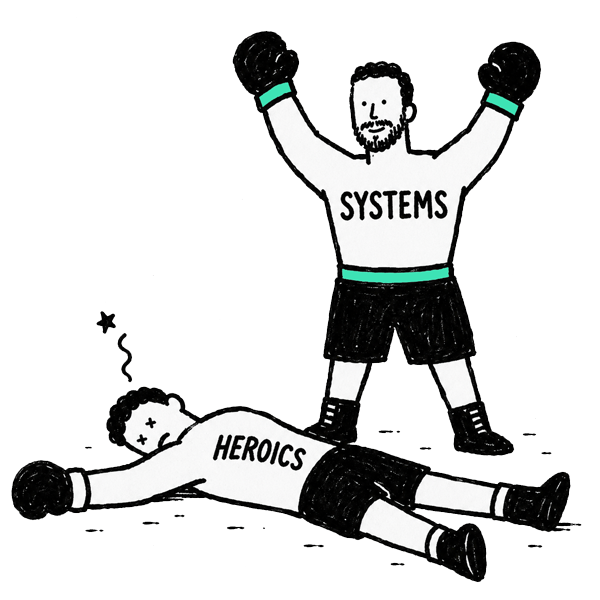
Systems beat heroics.
Great companies don’t scale through extraordinary people alone. They scale through systems that allow ordinary people to perform extraordinarily well.
Most companies massively overestimate the value of individual brilliance and massively underestimate the value of operational design.
You see it everywhere in growing businesses. Especially founder-led ones.
There’s always a handful of people carrying an absurd amount of weight. The salesperson who somehow keeps hitting numbers despite a terrible CRM. The operator holding together five disconnected systems with spreadsheets and memory. The customer success lead manually fixing onboarding gaps every week because nobody’s built the process properly. The founder answering emails at midnight because half the business still depends on them for decisions.
Those people matter of course. But heroics don’t scale.
In fact, constant heroics are usually evidence that the system underneath the business isn’t working properly.
That’s the bit a lot of companies miss. They celebrate the people compensating for the chaos instead of fixing the chaos itself.
You can get surprisingly far like that too. Revenue can still grow. Customers can still be reasonably happy. Teams can still look productive from the outside.
Meanwhile internally, the whole thing is held together with urgency, goodwill, and a few highly capable people quietly absorbing operational failure all day.
Eventually it catches up though.
Pipeline reporting becomes unreliable because nobody trusts the data. Leads get handled differently depending on who owns them. Customers receive completely different onboarding experiences. The same support tickets pile up because the root cause never gets solved structurally. Knowledge sits inside people instead of systems. And new hires take months to become effective because there’s no operational clarity.
Then someone leaves and everybody suddenly discovers they were manually bridging twelve process gaps nobody else knew existed.
I’ve genuinely seen businesses describe people as “irreplaceable” like it’s some kind of achievement. It isn’t.
If somebody is truly irreplaceable, the business has failed to operationalise what it knows.
Great companies need great people, but they don’t scale through extraordinary people alone. They scale through systems that allow fairly normal people to perform extraordinarily well.
That’s what operational maturity actually is.
It aint complexity. It aint bureaucracy. It’s not layers of management and giant process documents nobody reads.
Just clarity. Clear ownership, handoffs, standards, visibility and flows of information.
The companies that scale well usually make work easier than everyone else, not harder. That sounds fairly obvious, but it’s not very common.
Most growing businesses slowly accumulate operational friction everywhere. Tiny inefficiencies layered on top of each other over years. Extra approvals. Duplicate tools. Unclear responsibilities. Reporting nobody uses. Meetings replacing systems. Systems replacing thinking. People building workarounds on top of workarounds until nobody remembers what the original process was supposed to be.
And because growth can hide inefficiency for a while, leadership often mistakes movement for effectiveness.
Revenue covers a lot of sins until one day it doesn’t.
The shift from founder-led growth to operational scale is where this becomes brutally obvious. Because what got the business to $2 million usually breaks at $20 million.
The founder can’t stay in every decision. Sales leaders can’t manually inspect every deal. Customer success can’t rely on relationships and memory alone. Operations can’t scale through heroic effort forever.
At some point the business either builds systems or starts slowing itself down. This is why the best operators become slightly obsessed with reducing friction.
Not because they love process for the sake of it. Most good commercial leaders actually hate unnecessary process. What they want is momentum, speed, visibility consistency and predictability.
Systems create those things.
A good CRM system isn’t exciting. But a bad one quietly destroys commercial performance every single day.
A good onboarding system reduces churn before churn even exists.
A good reporting structure changes the quality of leadership decisions because people are finally looking at the same reality.
A good customer success process turns retention from luck into something measurable.
A good sales process reduces dependency on “naturally gifted” salespeople and makes performance coachable instead of mystical.
That part matters a lot.
Because businesses that rely entirely on exceptional individuals become fragile. Businesses built around repeatable systems become durable.
There’s a difference. One survives through intensity, the other survives through design.
And honestly, most people don’t give a shit about systems until the business starts breaking under its own weight. Until customer acquisition stalls because follow-up is inconsistent. Until onboarding becomes chaotic. Until support teams are drowning. Until forecasting becomes fiction. Until leaders realise half their week is spent clarifying things that should already be operationally obvious.
Then suddenly everyone wants systems. Usually too late.
The irony is that the best systems often feel almost invisible. They remove cognitive load. They reduce unnecessary decisions. They make expectations obvious. They help average performers improve faster because the path is clearer.
Good systems don’t remove human judgment. They create space for better judgment. Which is an important distinction.
Because operational maturity isn’t about turning companies into robots. It’s about removing avoidable randomness from the business so people can focus on work that actually matters.
Customers feel that difference too, even if they never articulate it properly.
You can feel when a company runs cleanly. The sales process makes sense. The onboarding feels coordinated. The communication is consistent. Problems get solved quickly.
The business feels calm underneath the growth. And that calm is rarely accidental. It’s usually the result of years spent building systems most people never notice.
Which is probably why immature companies keep undervaluing it.
Heroics are visible. Systems are quieter. But systems are what allow companies to scale without burning out their people, confusing their customers, and rebuilding the business every twelve months.
That’s why systems beat heroics every time.